

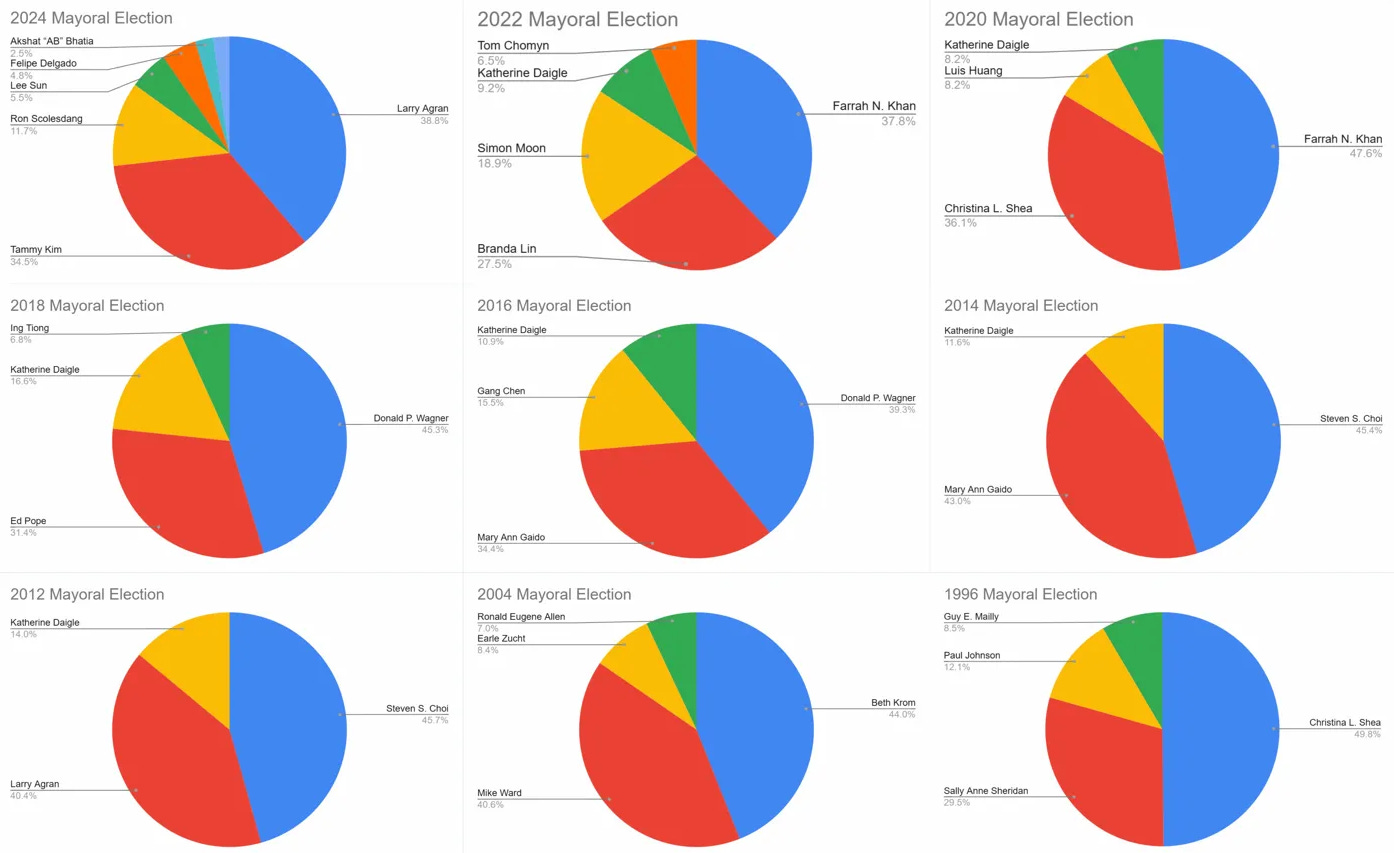
Start with a fact that ought to stop you cold.
In more than three decades of electing our mayor directly, the City of Irvine has never once handed that office to a candidate who won a majority of the vote in a race with more than two people on the ballot. Not in 1996. Not in 2004. Not in any election since. Every competitive mayor’s race in our city’s modern history has produced a winner that most voters voted against.
Look at the record:
2024 — Larry Agran, elected mayor with 38.8%.
2022 — Farrah Khan, re-elected with 37.8%.
2020 — Farrah Khan, 47.6%.
2018 — Donald Wagner, 45.3%.
2016 — Donald Wagner, 39.3%.
2014 — Steven Choi, 45.4%.
2012 — Steven Choi, 45.7%.
2004 — Beth Krom, 44.0%.
1996 — Christina Shea, 49.8% — the closest any contested race has ever come, and still short.
Note the pattern. It is not a fluke. It is the machine working exactly as a plurality system is built to work: when three or more candidates run, the winner needs only to finish first, not to finish above 50%. The majority is free to prefer someone else — and, election after election, it does.
Our new City Council seats tell the same story. In 2024, District 1 was won with 34.3%. District 3 was won with 44.0% — while the two other candidates split 56% between them. And in District 2, the winner took office with 30.9% of the vote. Read that again: nearly seven in ten District 2 voters preferred somebody else, and they got the one candidate the other 69% ranked behind.
This is what political scientists politely call “minority rule.” I would call it what it is: a structural defect in how we choose the people who spend our money and set our priorities. And right now those people are deciding how to close a projected $47 million budget gap over the next five years — decisions being made, in several cases, by officials a clear majority of their own constituents did not choose.
What is on the agenda Tuesday
On June 23, the Council had the chance to let the voters decide this question in November. When the moment came, Mayor Agran asked for a second to move the measure forward. Silence. He asked again. More silence. The measure to let the people vote died without a single colleague willing to say one word.
It should not have. And now it is back. Councilmembers Betty Martinez Franco, Melinda Liu, and Kathleen Treseder have re-agendized it, and this Tuesday, July 14, it returns as Item 5.7. The question in front of the Council is not whether they like ranked choice voting. It is whether they will trust you to decide it at the ballot box in November.
The measure itself is modest and carefully guardrailed. It reads: “Shall a measure that directs, to the extent technically and financially feasible, the use of ranked choice voting for City Council Member and Mayoral Elections occurring after January 1, 2028, be adopted?” It passes only with a majority of voters — 50% plus one. Note the operative phrase: to the extent technically and financially feasible. This is not a blank check and not a leap in the dark. It is a direction, conditioned on cost and capability, that Irvine join the growing list of cities that guarantee their leaders actually command majority support.
What ranked choice voting actually is
Ranked choice voting (RCV) is simpler than its opponents want you to believe. Instead of picking one candidate, you rank them — first choice, second, third, and so on; the Irvine ballot would let you rank at least five. You can still bullet-vote for one person if you like.
If a candidate wins an outright majority of first choices, that candidate wins — done, exactly like today. If nobody clears 50%, the last-place candidate is eliminated and their voters’ ballots move to those voters’ next choice. The count repeats until someone crosses a majority. It is an instant runoff — the second election happens automatically inside the first, with no separate trip to the polls. (The California RCV Institute has a good three-minute explainer if you want to see it in motion.)
The result is a winner who actually commands majority support, and a voter who never has to ask the miserable question our current system forces on us every cycle: Is my favorite “electable,” or am I wasting my vote? Under RCV you rank your true favorite first and your safe choice second, and both preferences count. As Irvine Watchdog’s Joshua Moore has written, democracy should never be government by those whom the majority does not want in office.
The spoiler problem is not hypothetical here
The deepest damage plurality voting does is not the honest split of a crowded field. It is the engineered split.
When a powerful interest wants to defeat a strong candidate, it doesn’t have to beat that candidate head-to-head. It only has to make sure a second, similar candidate enters the race and carves off enough support to let a third choice slip through with a minority. This is not a theory imported from a textbook. It is a recognizable feature of Irvine politics, and of California politics generally. In 2014, a lawsuit alleged that a Democratic congressional candidate had recruited Republicans to run and split the GOP vote; in 2020, a candidate in a Central Valley Senate race switched her party registration specifically to bleed votes from the other side. The tactic is bipartisan. It works on everyone. And it works precisely because we vote the way we do. RCV disarms it: split votes come home to the voters’ next choice instead of handing victory to a candidate the majority opposed.
Objection one: “It costs too much”
This is the objection I take most seriously, because we are in a budget squeeze. So let’s use real numbers — and read what the measure actually says.
The staff report the Council commissioned put the added cost of Irvine’s first RCV election in 2028 — new software, county coordination, ballot redesign, and a full voter-education campaign — at between $230,600 and $710,440, as the Voice of OC and the Orange County Register reported. Now set that against a general fund of roughly $310 million a year:
The high end — $710,440 — is 0.23% of the annual budget.
The low end — $230,600 — is 0.07%.
In later years, once the one-time software, training, and education costs are behind us, the recurring cost falls to a fraction of even that — on the order of a few thousandths of a percent.
But here is the part the “too expensive” crowd never mentions: the measure writes a cost ceiling directly into the ordinance. The added cost of that first ranked-choice election may not exceed 0.23% of the city’s general fund budget — and if the county’s price came back higher than that, the Council could defer implementation. Voters are not signing a blank check. They are approving a reform that, by its own terms, only takes effect if it is both feasible and affordable. This is about as fiscally cautious as electoral reform gets.
And there is a cost on the other side of the ledger that nobody who cries “too expensive” ever tallies: the cost of being governed, year after year, by officials most voters ranked second or third. Minority rule is not free. It is simply billed to a different account. For seven-hundredths to twenty-three-hundredths of a single percent of what we spend in a year — capped, conditional, and one-time — we can guarantee that every mayor and councilmember who governs this city carries an actual majority mandate.
Objection two: “It’s too confusing”
Voters are not the problem here. Under-explaining is.
Every California city that has adopted RCV has paired it with a public education campaign — and the evidence from those cities is not ambiguous. In Redondo Beach, which approved RCV by 77.5% in 2023 and used it for the first time in March 2025, post-election polling found that 87% of voters said they understood the system well and 61% favored it. Redondo is not a college seminar. It is a normal California beach city, and its voters picked it up without difficulty.
The turnout data cuts the same way. A 2024 peer-reviewed study found voters in RCV cities were 17% more likely to turn out in municipal elections than voters in comparable non-RCV cities, and youth turnout runs higher under RCV, not lower. A system that supposedly baffles people does not, as a rule, get more of them to the polls.
And here is the part the “too confusing” crowd never mentions: RCV only even applies when three or more candidates run for a seat. Two candidates? Your ballot looks exactly like it does today. When there are more, you are simply allowed to say more. That is not a burden. That is a bigger voice. If you want a live demonstration of why one choice is not enough, look no further than this year’s race for governor, where Californians are staring at a field of 61 candidates and are permitted to express a preference for exactly one of them.
Objection three: “This is incumbents rigging their own re-election”
A local blog has floated the charge that the councilmembers who proposed RCV are pushing it to save their own seats this November.
This one collapses on contact with a calendar. RCV, if adopted, would not take effect until 2028 at the earliest. The November 2026 election — including the races of the very councilmembers making the accusation-bait — will be run under the current plurality system no matter what. RCV cannot help any of them keep a 2026 seat. If anything, they are advocating for a system that would make their own future re-elections harder, by requiring them to earn a majority instead of squeaking through on a plurality. That is close to the opposite of self-dealing.
Objection four: “The majority promise is a myth”
The more sophisticated critique holds that because some voters don’t rank every candidate, their ballots can “exhaust” before the final round — so RCV doesn’t really deliver a majority.
Two responses. First, RCV delivers a majority of the continuing ballots in the final round — and even in its weakest case, that is a dramatic improvement over a status quo in which winners routinely take office with 31%, 34%, 38%. As Mari Fujii has pointed out, under our current system every single vote cast for anyone but the winner is “thrown out” — we just don’t call it that because we’re used to it. Second, ballot exhaustion shrinks when voters are allowed to rank the full field and are taught how — which is exactly what the voter-education money buys, and exactly what our current 31%-plurality system can never offer.
A system that produces a majority of counted ballots is not a myth. A system that hands power to a 31% plurality and calls it a mandate — that is the myth we live under now.
A fair question, honestly answered
Some thoughtful residents raise a genuine question: how often would ranked choice voting actually change who wins? If the same candidate usually wins anyway, is the change worth it?
It is the right question, and it deserves a straight answer. Often, the same candidate does win — and that’s fine; when a true majority favorite exists, RCV confirms it. In the minority of multi-candidate races where the first-round leader is not the majority’s real preference, RCV changes the outcome to the candidate a majority actually supports. But the value of RCV is not measured only in overturned results. It is measured in legitimacy: every winner carries a majority mandate, the spoiler incentive disappears, and candidates compete for second-choice support instead of tearing each other down. You do not judge a smoke detector only by the fires it puts out. You value it for the ones it prevents.
The credibility question
This is not a fringe experiment, and it is not a partisan gambit. Ranked choice voting has now been adopted in more than 60 jurisdictions across the country — Minneapolis, Salt Lake City, the states of Maine and Alaska, and even the Virginia Republican Party, which used it to choose its 2021 statewide nominees. In California, the charter cities of San Francisco (since 2004), Oakland, Berkeley, and San Leandro (since 2010), Albany (since 2022), and now Redondo Beach (2025) already use it.
The nonpartisan League of Women Voters — both the national organization and our own League of Women Voters of Orange Coast — supports enabling local jurisdictions to explore ranked choice voting, precisely because it maximizes effective votes and minimizes wasted ones. Their closing line is one every Irvine resident should sit with: “We respect the voters of Irvine to select the best voting method for their city.” Nearly every University of California campus, along with USC, Stanford, Caltech, and CSU Fullerton, already elects student governments this way. And our own voters, in March 2024, approved expanding the Council and moving to districts. Irvine is not afraid to modernize how it votes. We have done it before.
Even the Democrats of Greater Irvine resolution supporting this reform frames it not as a partisan advantage but as a matter of basic democratic legitimacy — because a spoiler split can, and does, victimize voters of every party.
What you can do before Tuesday
The cost objection has an answer. The confusion objection has an answer. The self-interest smear has an answer. What is missing is not evidence. What is missing is the will to trust Irvine’s voters with a choice — and this Tuesday, the Council needs to hear from you that they should.
There are three easy ways to weigh in on Item 5.7. If you want ready-made language, DGI has assembled a set of RCV talking points you can borrow from.
Submit an eComment or email the Council — before noon on Tuesday. You can file a quick eComment here (they’re capped at 1000 characters, so keep it short), or email the full Council at irvinecitycouncil@cityofirvine.org with the subject line “Support RCV Item 5.7.”
Show up on July 14. Item 5.7 likely won’t be heard until after 8:00 p.m., but arrive at the Irvine City Hall council chamber by 8:00 p.m. to be safe. Wear purple, or hold an RCV sign, and let the Council see that the room supports letting voters decide.
Speak — in person or by Zoom. You’ll get roughly 90 seconds to three minutes. To speak remotely, join the meeting on Zoom by 8:00 p.m. (Passcode 272906), enter your name, and use “Raise Hand” when Item 5.7 comes up. To speak in person, sign in at a kiosk by 8:00 p.m. and move to the front rows when the item is called.
Majority representation is worth it. It is worth a rounding error in the budget — one the measure caps at 0.23% and conditions on being affordable in the first place. It is worth an afternoon of learning a ballot our neighbors picked up without trouble. And it is certainly worth more than the silence this reform met last month.
On Tuesday, the Council does not have to adopt ranked choice voting. It only has to let you decide. Tell them to.