

Every spring quarter, on the first day of Physics 113A, Quantum Physics I at UC Irvine, I tell my students they are about to join a very small club
Roughly 100 students a year are taught quantum mechanics at UC Irvine. Maybe — optimistically — another 100 are taught at Chapman and CSU Fullerton combined. Over the past fifty years, that’s about 10,000 people in all of Orange County who have been formally taught the framework that describes the deepest known layer of reality. Out of a county of 3.2 million, that’s 0.3%.
Three out of every thousand people in OC have been taught what reality is actually made of.
I think that’s a problem.
Today, on May the 4th, I want to fix a tiny piece of it. Because the strange thing about the “true nature of reality” is that the conceptual core of it — once you strip away the calculus and the bra-ket notation — is something a journalism major with a part time job at Trader Joe’s can absolutely understand. I know, because I tried it.
The Trader Joe’s Cashier Who Asked Good Questions
Yesterday, I was checking out at Trader Joe’s, and the cashier, a thoughtful young man who told me he is a journalism major, asked what I do. I told him I’m a professor at UC Irvine, and he asked what I teach. (A pet peeve, since most of my time actually goes to research — but fair enough.) I told him quantum mechanics. He said, “Wait, so what is quantum mechanics, actually?”
He kept asking sharper and sharper questions while ringing up my groceries — from “what are your students learning?” to “what is Hilbert space?”
By the time I’d paid, I realized something: most popular explanations of quantum mechanics are bad. Not because the public can’t handle the ideas, but because physics discussion of quantum mechanics focuses on consequences, Schrödinger’s cat, the uncertainty principle, “spooky action at a distance,” instead of telling them what the theory says the world is.
So let me try, for him, and for you. And because today is May the 4th, a day to think about invisible things that bind the Universe together, let’s start there.
The Force Is Real. It’s Just Not What You Think.
In Star Wars, the Force is described as an energy field generated by all living things, something that surrounds us, penetrates us, and binds the galaxy together. That’s fiction, but it’s pointing at something true.
There really is something that surrounds us, penetrates us, and binds the Universe together. Physicists have a name for it. We can call it the wave function, but that’s a concept really just scratches the surface of the fundamental physics.
In modern physics, specifically, in the framework called quantum field theory that underlies the Standard Model of particle physics: the world is not, at bottom, made of particles. It is made of fields. An electron is not a tiny ball; it is a localized ripple in the electron field, a field that fills all of space. A photon is a ripple in the electromagnetic field. A quark is a ripple in a quark field. The Higgs boson is a ripple in the Higgs field. There is a field for every kind of particle in nature, and these fields are everywhere, all the time… even in the emptiest vacuum, the fields are still there, quietly humming with quantum activity.
What physicists call the wave function is the quantum state of any of those fields. It is the single mathematical object that captures what any field everywhere is doing, and their entanglement describes how all those activities are correlated with one another. Extrapolating, the collection of wave functions isn’t the state of one electron. It is the state of everything.
And the place where these wave function live, the actual stage on which the entire Universe plays out, is called Hilbert space.
This is where things get interesting.
What Is Hilbert Space?
Forget physics for a second and think about music.
A musical chord can be described in two completely different ways. You can describe the waveform, the wiggling of air pressure over time. Or you can describe the spectrum (in frequency space) which notes are in the chord, and how loudly each one is played. The chord is the same thing either way; you’ve just chosen a different list of “directions” to describe it in.
A Hilbert space is, roughly, a list of all the possible “directions” a physical system can point in. Not directions in the up/down/left/right sense, directions in an abstract space of possibilities. Each possible state of the system is a single arrow, a vector, pointing somewhere in this space.
For a single electron, the Hilbert space already has infinitely many directions, one for each thing the electron could possibly be doing. For the whole Universe, the Hilbert space is unimaginably vast. But it is still just a space of possibilities, and the actual state of the Universe is one specific arrow pointing through it.
A collection of arrows, the wave functions of everything, is what’s real. It evolves smoothly in time, governed by an equation called the Schrödinger equation, which is essentially the law of cause and effect at the quantum level.
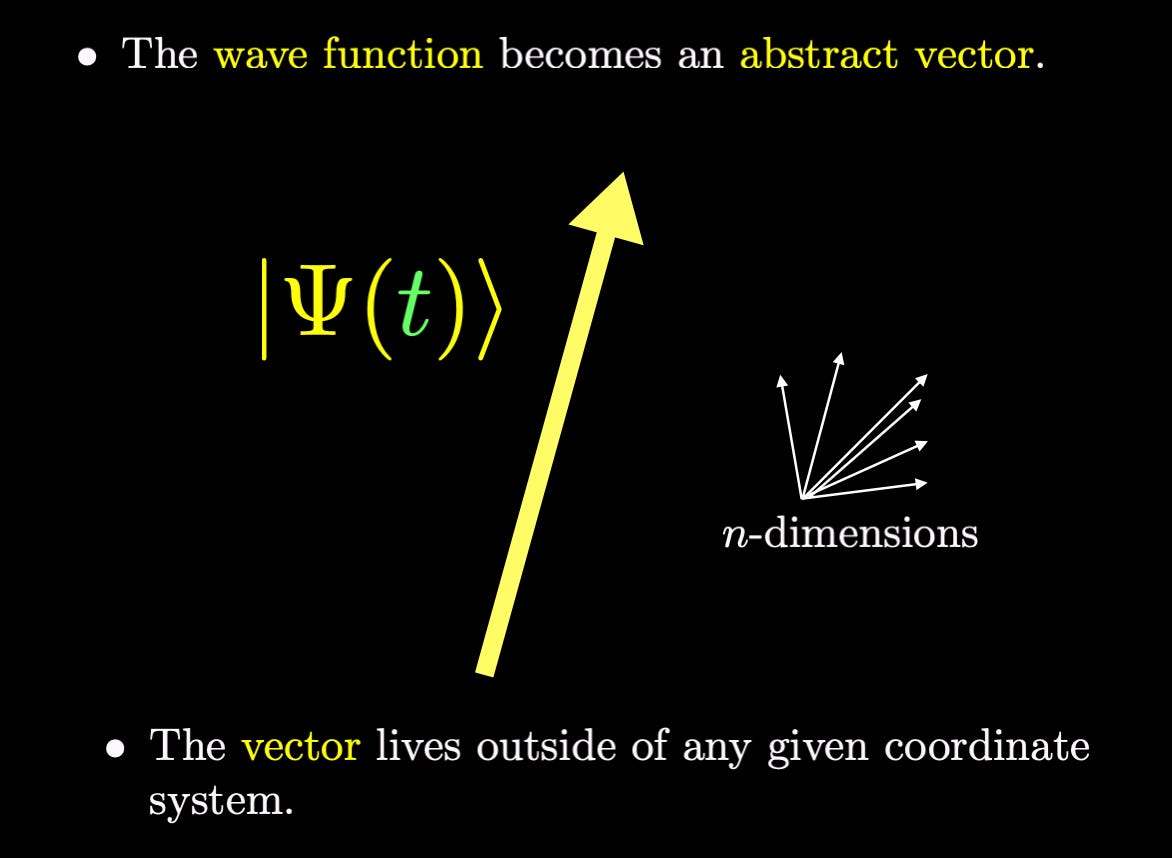
The picture at the top of this post is the slide I showed my students in their last lecture. It illustrates the simplest case: a single particle, say, one electron. The big yellow arrow is the particle’s wave function. The little label next to it, |Ψ(t)⟩, is just physicist shorthand for “the state of the particle at time t.” It turns out that time is always special and not just a property of projection, in this picture. The small fan of arrows labeled “n-dimensions” represents one possible coordinate system inside that particle’s Hilbert space: one specific set of “directions” you could lay down in order to describe what the big arrow is doing.
The line written underneath is the lesson I most wanted my students to leave with: the vector lives outside of any given coordinate system. The wave function is what’s real. The coordinate system you use to describe it is your choice, and that choice is the whole story behind what comes next.
Position Is a Choice, Not a Fact
When you ask “where is the electron?”, you are asking the wave function to express itself in a particular basis: the position basis. You are demanding that it tell you, for every point in 3D space, how much of itself is “there.”
But you could just as easily ask “how fast is it moving?” That’s the momentum basis. Or “how much energy does it have?” That’s the energy basis. Or “which way is its spin pointing?” That’s the spin basis. There are infinitely many equally valid questions.
These are all the same wave function. They are just different shadows of the same arrow, projected onto different walls.
The position description feels like the real one to us because we evolved with eyes and hands operating in a 3D world. But mathematically, position is no more fundamental than momentum or energy or spin. It’s just one shadow among many.
This is the moment when, in lecture, students start to look uncomfortable. Because if position is just one of many equally valid descriptions of the wave function, then what does it really mean to say a particle is “somewhere”?
Hilbert Space Fundamentalism
A growing community of physicists, including Sean Carroll at Johns Hopkins, and building on earlier work by Mark Van Raamsdonk, Brian Swingle, and others who study black holes and holography, has been pushing this question to its limit. The proposal, sometimes called Hilbert Space Fundamentalism, is breathtakingly simple:
The wave function in Hilbert space is all there is. Three-dimensional space is not fundamental. It emerges.
On this view, the Universe is fundamentally an arrow evolving through an abstract mathematical space. There is no underlying 3D grid sitting underneath everything. The feeling of three dimensions, the existence of distinct objects at distinct locations, the very notion of “here” and “there”… all of it is a pattern that emerges from how different parts of particle wave functions are entangled with each other.
Bits of the wave functions that are heavily entangled appear “near” each other. Bits that are weakly entangled appear “far apart.” Space itself is woven out of quantum entanglement.
If this is right, and there are very good reasons from the boundary of gravitational physics and quantum physics to think it might be, then the room you are sitting in, the screen you are reading this on, the distance between your hand and your face, are not fundamental features of the world. They are emergent — which is a very different thing from being unreal. Emergent things are entirely real: a hot stove is still hot, even though “heat” is really just the motion of atoms.
The mechanism that turns the abstract wave function into the solid, classical, three-dimensional world you actually experience has a name: decoherence. When a large object interacts with its surroundings, every photon and air molecule brushing against it, most of the abstract possibilities in Hilbert space get suppressed almost instantaneously, and a small set of stable, classical-looking descriptions takes over. For macroscopic things, the description that survives is the one in which objects have definite positions.
So at the level of a single electron, position really is just one basis among many. But at the level of your coffee cup, the rest of the Universe has effectively forced the position basis on us. The cup is real. The room is real. They are what the underlying wave functions, the more fundamental structures beneath the classical world, look like after decoherence, in the basis decoherence has picked out.
The Force, in other words, is not a metaphor. There really is a set of mathematical objects that surround us, penetrate us, and bind the galaxy together. We are patterns inside them.
Welcome to the 0.3%
If you got this far, here is what you now know that almost no one in Orange County has ever been told:
The fundamental object in the Universe is not a particle and not a field. It is a wave function — an arrow in an abstract space of possibilities called Hilbert space. The position of things in 3D space is just one of many equally valid ways of describing that arrow; there is nothing special about it from the wave function’s point of view. And, it seems, 3D space itself is not fundamental at all. It may emerge from the entanglement structure of the universal set of wave functions.
You didn’t need the math. You needed someone to actually tell you what the theory says.
So: welcome. You’re in the 0.3% now. You know what the world is made of, as far as our best physics can currently tell.
May the 4th be with you.
—
Note: if you want to explore further, check out Sean Carroll’s “Reality as a Vector in Hilbert Space” essay or his book Something Deeply Hidden for further reading.
"The vector lives outside of any given coordinate system." That single line is the key to everything.
If the wave function is what's real, and 3D space is emergent from entanglement structure, then the fundamental layer of reality is already abstract, atemporal, and complete. Not a physical stage that things happen on. A mathematical structure that contains all possibilities simultaneously.
The Wheeler-DeWitt equation takes this one step further. When you apply the same logic to the universe as a whole, the time derivative vanishes entirely. The universal wave function doesn't evolve. It simply is, outside of time, containing all configurations simultaneously.
Space emerges from entanglement. Time emerges from local perspective. What remains is a complete, atemporal structure that was never in the process of being built.
Welcome to the 0.3%. The view from here is strange and beautiful.