

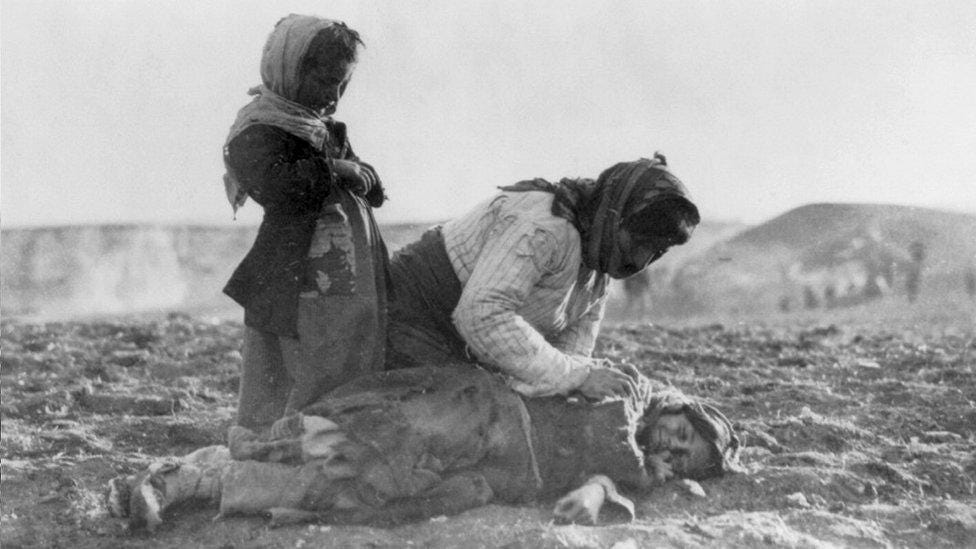
The words we use about the past shape the future. When leaders deny genocide, they invite it to continue.
Here we are — today — at 110 years since the widely recognized start of the Armenian Genocide, and it is more clear than ever that the Armenian cause is not just about a single people’s history—it is about the future of humanity.
We Armenians were the first to suffer the full force of industrialized, identity-based violence in the modern era. The Armenian Genocide of 1915-1923 was a systematic attempt to erase a people, carried out with technological and bureaucratic precision. That model—combining nationalism, propaganda, and state machinery—became the template for horrors that followed: the Holocaust, Rwanda, Bosnia, and more.
In response, the world said, “Never again.” The United Nations was born out of that promise. So was the Genocide Convention. We collectively agreed that identity-based annihilation was a threat to global peace and could not be tolerated again.
But here we are, in 2025, watching the resurgence of such genocidal violence across the globe.
Armenians in Artsakh have been killed and forcibly displaced in what is truly the continuation of the Armenian Genocide that started in the late nineteenth century. Ukrainians continue to resist a brutal invasion aimed at erasing their national identity. Palestinians and Israelis face genocidal devastation in a cycle of conflict where civilian lives are devalued. Uyghurs in China are interned and repressed on a massive scale. The Rohingya remain stateless and under siege. The Masalit in Sudan’s Darfur region are once again targets of mass violence. We are seeing a world where all the great powers are directly participating in genocide or complicit in it.
And now, President Donald Trump has doubled down on his denial of the Armenian Genocide—a crime against history and humanity. His words embolden regimes around the world to do the same, and worse, continue the worst crimes against humanity.
Genocide denial is a revisionist history—and a signal—a green light for others to erase, to suppress, to kill. It undermines international law, violates the spirit of the UN Genocide Convention, and betrays the United Nations Declaration on the Rights of Indigenous Peoples, which affirms the right of all peoples to survive, to thrive, and to be free from erasure. We appear to be entering a period in unfolding world history where might makes right, and identity-hatred based nationalistic violence can spiral into global conflict at a time when the most destructive tools of war are available: nuclear weapons.
The denial of genocide—especially by the U.S. president—is a profound threat to peace. It says that crimes against humanity are negotiable, deniable, expendable. That memory can be manipulated and justice discarded.
We cannot let that stand.
Here in Orange County, we have tried to respond not with silence, but with action. After the former Mayor of Irvine praised the genocidal state of Azerbaijan, participated in anti-Armenian hate speech and promoted genocide deniers, we didn’t just protest—we organized. We hosted a screening of the documentary Motherland in Irvine City Hall, where three Councilmembers stood with us. We have worked with the City through five stages of approval to move forward with the creation of Orange County’s first public Armenian Genocide memorial at the Great Park.
But the challenges persist. Just last October, the City of Irvine invited Azerbaijani state officials to the Global Village Festival—a year after Azerbaijan’s genocidal ethnic cleansing of Armenians from Artsakh. I confronted their Vice-Consul and demanded he dissociate himself from the genocidal actions of his government. He responded with cold denial and deflection. When this encounter was exposed online, it drew the attention it deserved—but also revealed how far we still have to go.
Still, there is progress. The former mayor who promoted anti-Armenian rhetoric is gone. New Irvine Mayor Larry Agran has pledged $1,000 to support the Genocide memorial. Other councilmembers—James Mai, William Go, Melinda Liu, Michael Carroll, and Kathleen Treseder—have voiced support as well. That’s the power of sustained local action.
Because the truth is, justice is not an abstract concept. It’s built in our cities, in our neighborhoods, by people who show up, speak out, and refuse to forget.
Being Armenian American means living with complexity. We are survivors of genocide and citizens of a nation that, at times, enables new atrocities. That contradiction can paralyze us—or it can call us to act.
And the best way to act is to be excellent at what we do. In our professions, our communities, our politics—we gain leverage when we lead, when we build, when we speak with moral clarity.
We must push back against the normalization of denial. We must hold our leaders accountable, whether they sit in Irvine City Hall or the White House. And we must defend the principle that every people, everywhere, have the right to exist in dignity and peace.
The Armenian cause is the human cause. And in fighting for it, we fight for a world where genocide is not just remembered—but halted and prevented.