

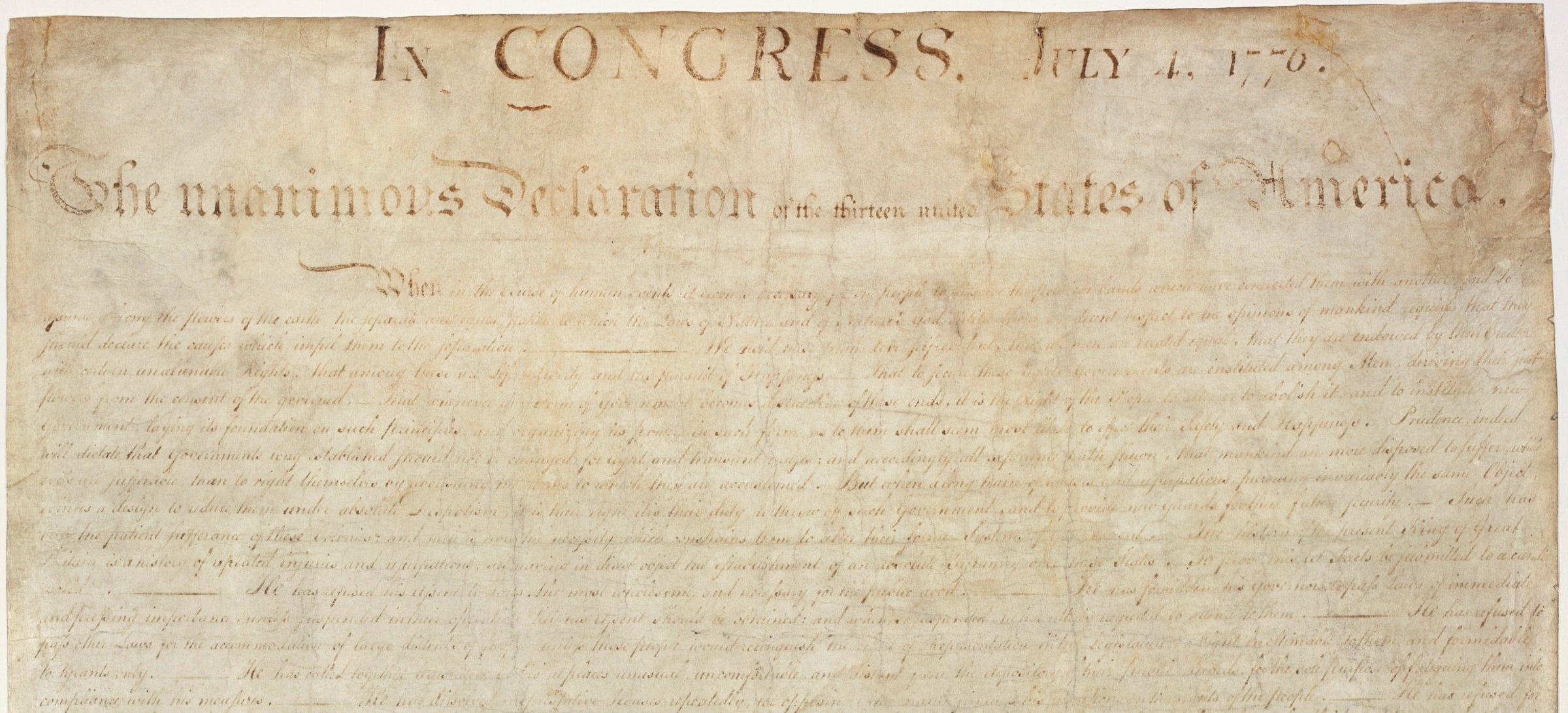
Two hundred fifty years ago today, fifty-six men signed a document asserting that governments derive “their just powers from the consent of the governed.” Not from the consent of the incorporated. Not from the consent of the wealthiest. The governed.
The story is usually told in the register of vague lament — money in politics, the system is broken, everyone knows. Vagueness is the friend of the people who benefit. So let me be a physicist about it and stack the measurements.
Start with the framework. A representative democracy is supposed to produce congruence: what the government does should track what its citizens want. Political scientists measure this, and for the United States the measurement is damning. In Affluence and Influence, Princeton’s Martin Gilens examined roughly two thousand policy questions and found that when the preferences of affluent Americans diverge from everyone else’s, the affluent win and the rest lose — regardless of party. American policy already tracked the wealthy. That was true before 2010.
Then came the ruling.
In Citizens United v. FEC (2010), five justices held that restricting independent political expenditures by corporations and unions violates the First Amendment. Months later, the D.C. Circuit’s SpeechNow.org v. FEC built the super PAC, the vehicle for unlimited “independent” money, through the door Citizens United had opened. In 2014, McCutcheon v. FEC struck the aggregate limits on what a single donor could give. Justice Stevens, in dissent, called the majority’s reasoning “a rejection of the common sense of the American people.” He was right… and it has been overruled ever since.
Note that this is not opinion. Citizens United handed social scientists something they rarely get: a clean natural experiment. The ruling invalidated bans on corporate independent expenditures in 23 states while leaving the others untouched. Compare the two groups before and after, and you read the effect of the money straight off the data.
Here is what they found.
The same Martin Gilens, with Shawn Patterson and Pavielle Haines, in the American Political Science Review in 2021, showed that after the bans fell, the “treated” states adopted more corporate-friendly policies: roughly a 4 percent cut in the top corporate income tax rate, about 8 percent in states that had banned only corporate spending. And the tell (what makes this a smoking gun and not a coincidence!) is that the shift appeared only on issues affecting corporate welfare. On policies with no corporate stake, nothing moved. Not states drifting rightward. Corporations buying the specific outcomes corporations wanted.
The elections shifted too. Klumpp, Mialon, and Williams, examining more than 38,000 state legislative races, found Citizens United raised Republican win probabilities about four percentage points overall, and ten or more in several states. The Roosevelt Institute’s synthesis puts it plainly: state governments shifted right by 4 to 11 points with no corresponding shift in voter ideology.
Read that again. Representation moved. The voters did not. That gap, between what citizens wanted and what money delivered, is the precise thing the consent of the governed is meant to prevent. Citizens United manufactured it.
And then it scaled. Outside spending has exploded more than 28-fold since 2008 — from $144 million to over $4.2 billion in 2024. That year, one hundred billionaires poured a record $2.6 billion into our elections, nearly 20 percent of all money spent — and in 2018 the top 1 percent of donors supplied 96 percent of all super PAC funds. The political influence of the most wealthy has never been stronger in the modern era.
The cleanest measure is the simplest. Before Citizens United, billionaires supplied well under 1 percent of all federal political contributions — 0.6 percent in 2000, 0.3 percent in 2008. After the ruling, their share detonated: 3.7 percent by 2012, and 16.5 percent by 2024.
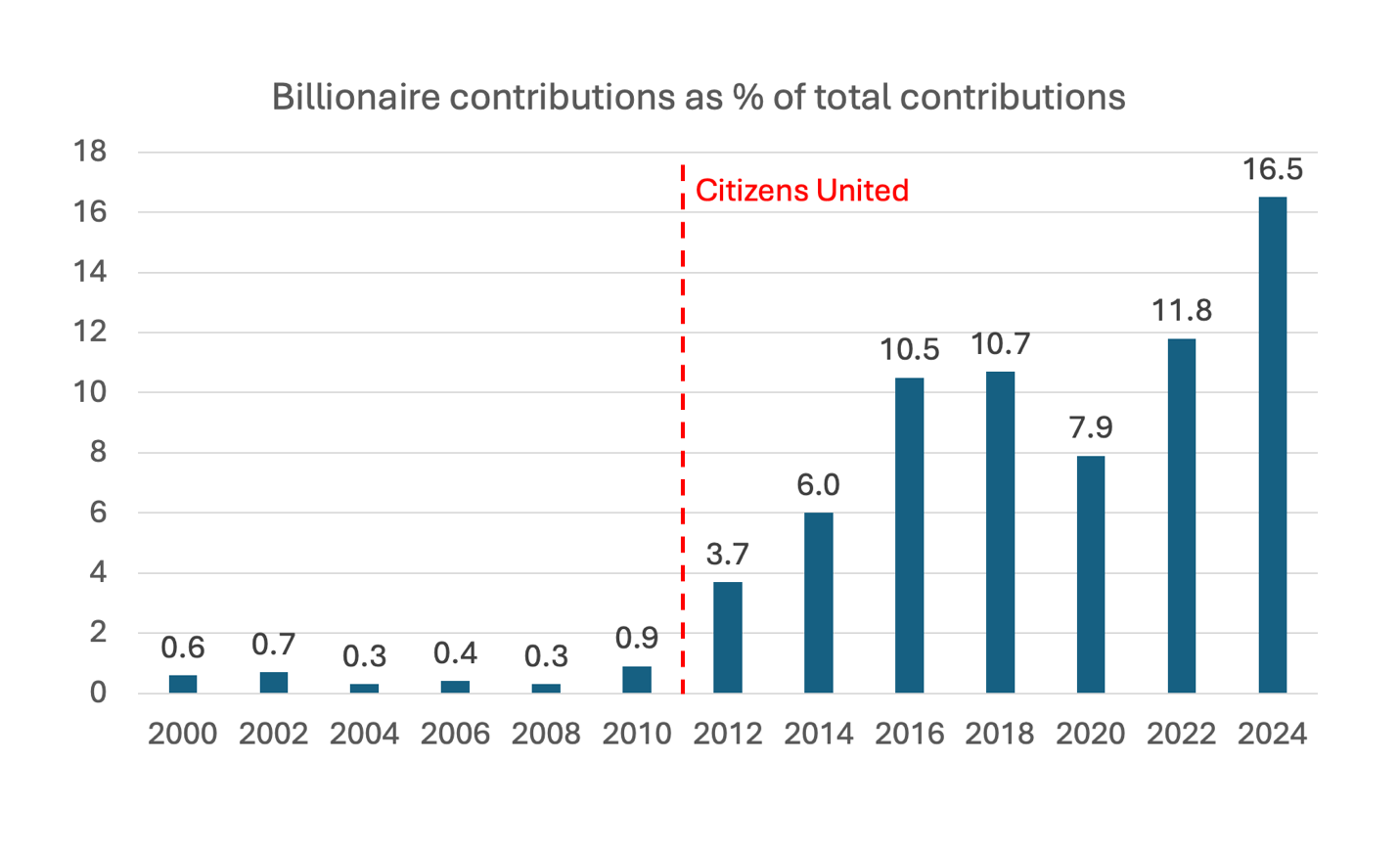
And no, this is not simply because there are now more billionaires. As Paul Krugman has noted, the number of American billionaires grew 85 percent between 2010 and 2023, from 404 to 748, while their share of political contributions grew 1,700 percent. Economists who study the very top now find wealth more concentrated than it was in the Gilded Age itself. The money did not merely accumulate. It was unleashed.
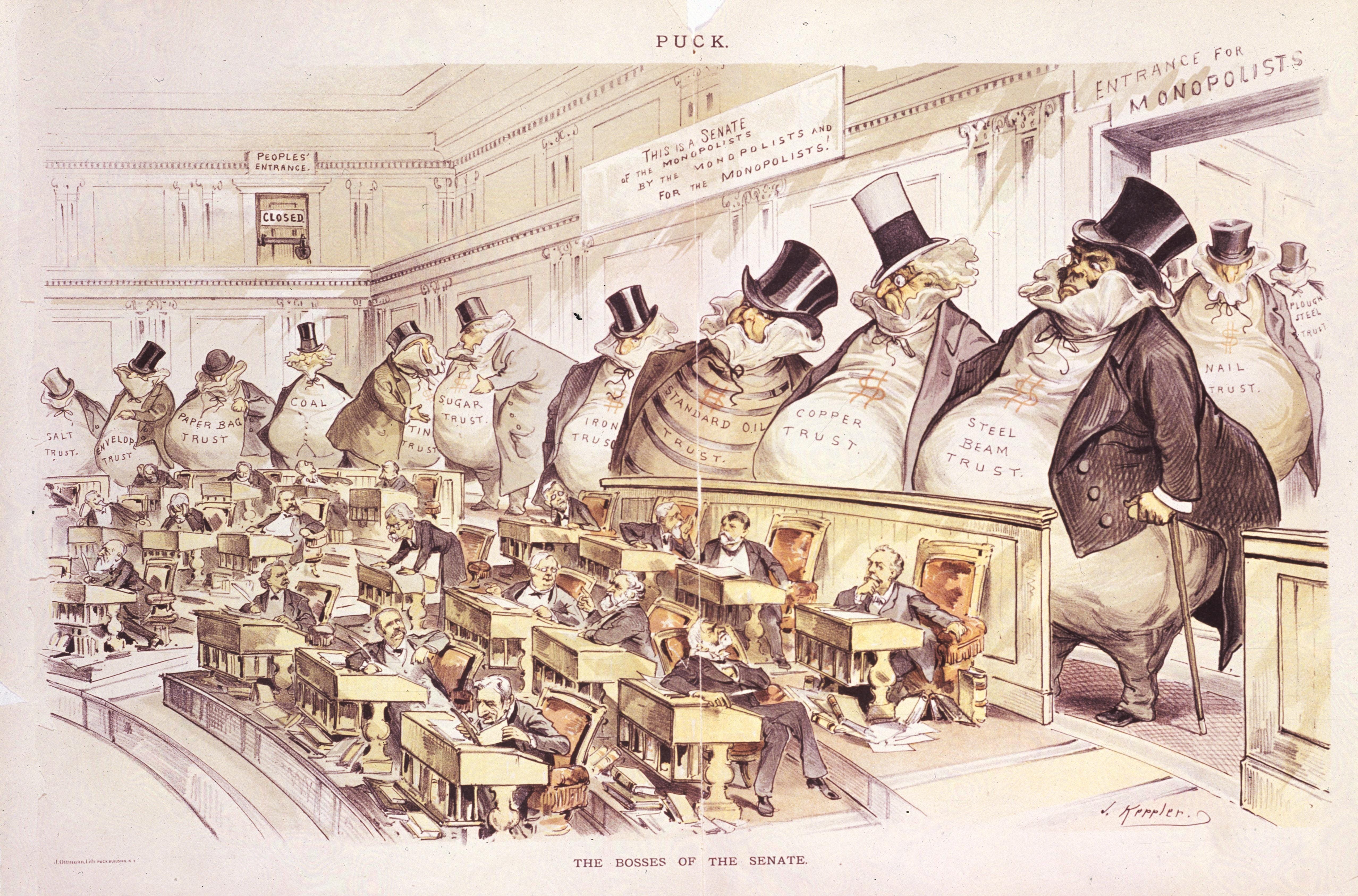
We have seen this before. In 1889, Joseph Keppler drew the United States Senate for Puck as a chamber of bloated money-bags (Standard Oil, Steel, Copper, Sugar, Coal) towering over shrunken senators beneath a banner: a Senate “of the Monopolists, by the Monopolists, and for the Monopolists.” In his drawing, the People’s Entrance is bolted shut. And here is the part worth remembering today: the country looked at that cartoon and answered it. The Sherman Antitrust Act followed the next year. Americans spent a generation breaking the trusts, and in 1913 amended the Constitution so that senators would be elected by the people rather than delivered by the bosses. We have done this before. Then, in 2010, five justices reopened the Monopolists’ Entrance, and handed the money-bags a First Amendment to carry through it.
If all of that feels abstract, come home with me to Irvine, where I have watched it run a single city council.
In 2014, Great Park developer Heritage Fields El Toro routed at least $150,000 into a chain of political action committees, and then-Councilmember Larry Agran named it exactly: “Citizens United on steroids at the local level.” In 2016, PACs funneled $1.1 million into Irvine’s municipal races: 43 percent of it spent to destroy one slow-growth mayoral candidate, planning commissioner Mary Ann Gaido. The California Homeowners Association PAC alone spent $255,305 against her and $172,140 for the developers’ slate. Independent expenditures for mayoral candidate Don Wagner reached $274,065, nearly 25 times the $11,177 his own campaign spent. His campaign barely had to exist. The money ran the race.
It did not stop. In 2018, developer-aligned PAC money topped $403,000 for Wagner, $228,000 for Anthony Kuo, and $214,000 for Carrie O’Malley. In 2020, FivePoint and The Irvine Company pushed over $400,000 into groups boosting their chosen candidates and burying their opponents, laundered through a vehicle innocently named the “Greater Irvine Education Guide.” Four consecutive elections. The same handful of development interests. The same fake-newspaper mailers and shell PACs. In a city of more than 100,000 people, a few developers with a land-use agenda have served, cycle after cycle, as the electorate that actually counts.
Now, the honest objection, because I will not pretend it away: the affluence bias predates 2010. Gilens’s original data run back to 1981. The rich were overrepresented before the Roberts Court ever heard the case.
True… and it is the strongest argument for my thesis, not against it. A pre-existing disease that the Court then declared constitutionally protected is not a lesser offense; it is a graver one. Citizens United did not invent the corruption of our politics by money. It took that corruption, blessed it as speech, and locked it behind a constitutional door ordinary legislation cannot reach. That is why this reform, and not another, is the keystone. Pass ranked-choice voting, improve turnout, redraw fair districts: every one of those reforms still operates inside a system where a developer’s checkbook outvotes a precinct. Fix the money and the rest finally deliver. Leave it in place and they are landscaping around a foundation crack.
So here is the single biggest change, and it is not complicated. Overturn Citizens United. At least 22 states and hundreds of cities have already called for the constitutional amendment to do it, the Democracy for All Amendment, restoring the power of Congress and the states to limit political money. Pass the DISCLOSE Act, so no dark-money check can hide behind a name like “Greater Irvine Education Guide.” Enact the Freedom to Vote Act. Build small-donor public financing, so a candidate can win on ten thousand neighbors instead of ten donors. Refuse corporate PAC money, and dare your opponent to explain why he won’t.
And California need not wait for Washington. The route runs through the nature of a corporation itself: not a person born with rights, but a creature of state law that holds only the powers the state grants it, and can decline to grant. That is what North Coast Assemblymember Chris Rogers proposed in AB 1984, which rewrites California’s Corporations Code to say plainly that a corporation operating here has no power to spend in our elections, forfeiting its charter privileges if it tries, reinstated only after disgorging every dollar.
And this is no longer theoretical. In May 2026, Hawaii became the first state in the nation to do exactly this: Governor Josh Green signed Act 11, stripping corporations and other “artificial persons” of any power to spend in Hawaii’s elections — unanimously in the state Senate, 50–1 in the House, with Republican votes. It will be sued; the corporate bar has promised as much, and even Hawaii’s own attorney general doubts it survives. Good — let them go to court and argue, on the record, that a corporation has a constitutional right to a power the people never granted it. The distinction they run into is one the Supreme Court has never touched: Citizens United bars government from silencing a corporation that already holds the power to spend; it does not require a state to hand that power over in the first place. It is a simple-majority statute, not a constitutional amendment (no five justices required!) and Montana’s voters may ratify the same principle at the ballot box this November. California, where the corporate checkbook buys city councils outright, should be next.
Note whom this reaches. The Irvine Company. FivePoint. Heritage Fields El Toro. Starpointe. The precise corporate checkbooks that have run Irvine’s elections for many cycles, stripped of their electoral power not by censoring any person’s speech, but by refusing to hand an artificial entity a political power the people never granted it. Rogers named the lie at the ruling’s center: the majority assumed unlimited corporate spending would not corrupt, and “the Court was wrong.” Nearly 80 percent of Americans agree that large independent expenditures breed corruption or its appearance: 84 percent of Democrats, 74 percent of Republicans, 79 percent of independents. Not a partisan wish. One of the last things Americans of every party still agree on.
And right now AB 1984 is stalled: re-referred this spring into the Assembly Banking and Finance Committee, where inconvenient bills are quietly starved of a vote. It must be revived. When it returns, every Californian who means a word of what we celebrate today should demand their Assemblymember pass it.
End Citizens United has assembled this agenda, and the agenda is correct. What it lacks is not evidence…. I have stacked the evidence above. What it lacks is us.
Two hundred fifty years ago, the charge against the Crown was that it had made government answerable to something other than the people. We won that argument on a battlefield. We are losing it now at an auction. The consent of the governed cannot be purchased, outspent, or incorporated, and on this Fourth of July, the most patriotic thing an American can demand is that it never again be for sale.
What you can do
Push AB 1984 back to life. It stalled in the Assembly Banking and Finance Committee. Tell your Assemblymember to revive and pass it. (For Irvine, this is Assemblywoman Cottie Petrie-Norris.) Track the bill.
Back the federal fixes. Urge your members of Congress to co-sponsor the Democracy for All Amendment and to pass the DISCLOSE and Freedom to Vote Acts. (For Irvine, this is Congressman Dave Min.)
Reward the refusers. Support candidates who reject corporate PAC money — and ask the ones who won’t why not.
Break the silence. The supermajority against this system already exists. Its silence is the only thing keeping the system standing.