

On Saturday, April 25, the Mayor of Irvine texted me in the morning. He wanted to meet that afternoon. We sat down at 2 p.m. at a coffee shop near UC Irvine. My son’s birthday party was at four.
Within two minutes, the Mayor told me he was removing me from the City’s Sustainability Commission. The reason, he said, was that I’d released a report three days earlier that he disagreed with. He said he wanted the removal in place before the Council meeting on Tuesday.
By Wednesday, I’d been reinstated.
In the four days between, the Irvine City Council voted down the policy item my removal was apparently meant to support. A sitting Councilmember called the whole spectacle “theater of the absurd” from the dais. And a longtime volunteer for the Mayor’s prior campaigns gave a public comment asking him to step down.
That’s what happened. What I want to do here is walk through the public record, which is unusually clear in this case, and tell you what I think it shows.
(Video clips of the moments referenced below are available in the appendix at the end of this post.)
The Report
On April 22 I released the Climate Crisis Action Report, an Earth Day update to a report I’d written for the city in 2021 on Irvine’s renewable-energy potential. Its scope is the City’s full climate picture, not just one sector. I also highlighted the report in an Irvine Watchdog Op-Ed.
My 2026 report’s starting point is the 2019 greenhouse gas inventory the city released in 2023. Total community-wide emissions for Irvine that year came to about 2.25 million metric tons of CO₂-equivalent (MTCO₂e). Three sectors dominate:
On-road transportation: 1,144,205 MTCO₂e, 51% of the total. Gasoline and diesel burned on Irvine roads.
Electricity, residential plus non-residential: 501,715 MTCO₂e, 22%. The carbon attached to the electrons flowing into our homes and businesses, mostly from fossil-fired generation upstream of the wire.
Natural gas burned in buildings: 335,322 MTCO₂e, 15%. Stoves, furnaces, water heaters, dryers, burning a fossil fuel.
Together those three sectors account for 88% of Irvine’s emissions. Everything else, including municipal operations, off-road vehicles, water, wastewater, and waste, makes up the remaining 12%.
Just to give the big picture as a physicist: when 88% of a problem sits in three buckets, those are the three buckets you go after. The smaller items are still important, but they are an order of magnitude or more smaller than the dominant terms, and the carbon math is the carbon math. The report makes this concrete in a chapter on urban forestry: offsetting Irvine’s community emissions through tree planting alone would require roughly 75 million new trees a year, against a City plan to plant 1,900. A tree is a good thing. Seventy-five million trees is not a policy. As a scientist working to find an optimal solution, you go where the numbers are, and they point to changing these top three carbon emission sources, not political theater.
The recommendations in the report follow the numbers, sector by sector. For natural gas, the largest pollutant inside the homes our kids breathe in: halt new gas infrastructure now and provide loans for the conversion of existing buildings to electric heat pumps and induction. For transportation, the largest sector overall: a municipal EV purchase-loan program, fast charging at every city park and large multi-family complex, and an electric-bus-forward redesign of the Irvine CONNECT shuttle so that it stops being, by my analysis, a small net carbon emitter. For electricity: enroll the City of Irvine’s accounts in OCPA’s 100% Renewable Choice tier, and scale municipal financing so residents can install rooftop solar, batteries, and heat pumps at zero upfront cost.
A note on that last sector, since it’s where things got contested this week. OCPA’s default tier, “Basic Choice,” came in at roughly 942 pounds of CO₂ per megawatt-hour in 2024. SCE’s default came in at 515. The report doesn’t hide from that number. But the recommendation isn’t to leave OCPA. It’s to opt up. OCPA also offers Smart Choice and 100% Renewable Choice tiers, both of which beat SCE on carbon. Leaving OCPA gives up local control of procurement. Opting up uses that control. The rate disparity that’s driving the political pressure, meanwhile, is mostly a state-level exit fee called the PCIA, which the statewide CCA association has now formally challenged in court. And, we expect SCE to increase their rates in June.
The report was scheduled for presentation to the Commission members at the Sustainability Commission’s May 13 meeting. Three days after I released it, I was sitting in a coffee shop with the Mayor.
At Council
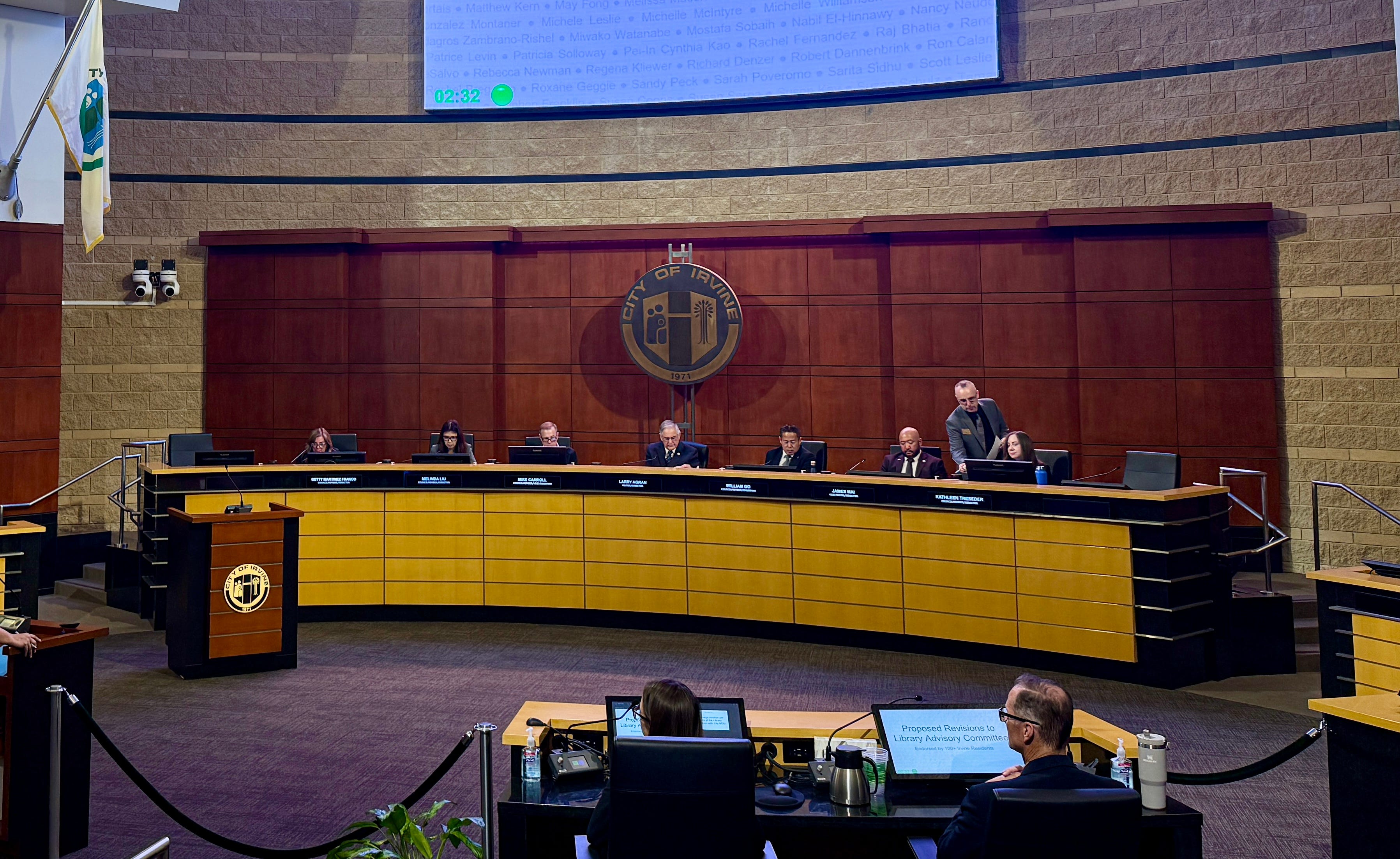
Item 5.5 on the April 28 council agenda was a proposal to move Irvine from OCPA to SCE. Councilmember Treseder moved to delete it. Councilmember Go seconded. Three voted yes (Treseder, Go, Mai), two voted no (Agran, Carroll), two abstained (Liu, Martinez Franco). Under Irvine municipal code, abstentions count as ayes. The item was deleted five to two.
Dr. Treseder, who has been on council nearly four years, didn’t pretend this was the first time around the block:
“I’ve been on the Council for almost four years, and that time, I think this is the 10th time that the mayor has agendized attacking OCPA. It happens pretty regularly. Each time, the Council has voted it down, each time.”
Then she named the dynamic in the chamber:
“Most of the people who have been here speaking against this item are the mayor’s people. And you can tell who they are. They tend to be the ones who rely more on bullying than on speaking to the facts. And I think it’s almost become, I feel like, a theater of the absurd, where we all know up here who Larry’s people are. … We all know who the mayor’s people are. And we’re being kind of required to ignore that up here and pretend like these are all independent commenters.”
On my removal:
“We have seen… the mayor’s commissioners come in and speak and always support the mayor. But this time, this latest time with [Dr. Abazajian], he did not. And so he was removed.”
One thing Dr. Treseder mentioned from the dais deserves to sit on its own. She had previously gone to significant institutional effort to get the Mayor access to the unredacted power purchasing agreements that govern OCPA’s electricity procurement. Those are the actual contracts. They show, in non-public detail, what’s being bought and at what price. The Mayor had insisted he needed to see them in order to evaluate OCPA.
“And that took a lot of work. … None of the mayor’s staff ever looked at it.”
Sit with that for a second. The contracts the Mayor said he needed in order to evaluate OCPA were obtained at significant institutional cost. No one on his staff read them.
Councilmember Carroll voted against the deletion on procedural grounds. He thought the Council should hear the item rather than delete it outright. That’s a reasonable view, and we disagreed about it. But he didn’t pretend the floor was new. Of Treseder’s tenth-time observation he said, simply, “It has been heard numerous times, indeed it has.” From the dais, he addressed me directly, with a generosity I want to put on the record:
“I do want to speak to my working colleague and friend Kev, the president of the Democrats of Greater Irvine. … I’d consider you for sustainability. I already have someone in the slot, and we’d have to work some things out, but it’s not my election year, so I would consider it.”
We disagreed on the procedural vote, and he was kind to me on the record. Both belong in any honest account.
The public microphone delivered surprises of its own. Doug Elliott, who serves on OCPA's Community Advisory Committee, spoke twice. The first time he borrowed his frame from An Inconvenient Truth and called my removal “a tragic loss for Irvine,” adding that "the public interest is best served when commissioners can exercise their independent judgment on matters within their jurisdiction." The second time, on the deletion of Item 5.5 itself, he called the recurring OCPA-attack agenda items “Groundhog Day” and reminded the chamber, plainly, that “we're not going to get to sustainability without OCPA.” Jeremy Ficarola, who said he’d volunteered hours to the Mayor’s previous campaigns, used his minute to ask the Mayor to step down (see video record below).
A Critique, Briefly Engaged
One of the Mayor’s surrogates spoke during public comment to challenge the report. The critique had three threads worth addressing.
The first was that the report’s title page, which lists my affiliations with the Sustainability Commission and the university, “could be taken to imply” institutional endorsement. The report addresses this directly on page 5, in a section titled “Authorship and Scope,” which states that the document “should be read as a commissioner’s perspective intended to stimulate discussion, not as an adopted position of the Commission or the City.” The disclaimer is in the document, in plain English, immediately after the introduction.
The second was an insinuation that I’d been compensated “in any way” for the report. For the record: no. I’ve done volunteer civic work on Irvine environmental committees for five years. This report included. I am a salaried faculty member at UC Irvine, as the title page indicates, but no one — UC Irvine, the City, OCPA, anyone — paid me to write this report or shaped its conclusions.
The third was that the report ignores the California Renewable Portfolio Standard, the state’s 100%-clean-by-2045 mandate. This is a category error. The RPS is a floor. It’s the minimum the state will eventually require. Irvine’s own ACHIEVES Resolution and CAAP commit the city to a faster timeline than that, which is the entire reason a city has its own climate plan. If the answer to every local question is “wait twenty years for Sacramento,” there’s no point in having a Sustainability Commission at all.
A final claim was that the report’s numbers are “way, way off.” No specific figure was named by Ms. Johnson. The numbers come from the 2024 Power Content Label, the 2019 greenhouse gas inventory, and EPA’s standard equivalency factors. Each is footnoted. Anyone who wants to examine them is welcome to.
The Inconsistency
Step back from the meeting itself for a minute. There’s a contradiction in the Mayor’s position that’s worth naming.
For years, he’s argued that OCPA’s clean-energy procurement is meaningless because, as he likes to put it, “you get the same electrons as your neighbor no matter what.” On the physics, at the wire, that’s true. Electrons don’t care which utility paid for them. But on the climate, it’s beside the point. Procurement decides what gets built and burned upstream of the wire, which is the entire question.
This week, the Mayor and his surrogates argued the opposite: that OCPA Basic Choice’s higher carbon intensity is a reason to leave for SCE.
You can’t have it both ways. If procurement doesn’t matter, OCPA’s carbon number is meaningless and not a reason to leave. If the number matters — and it does — then procurement matters, and the right move is to enroll Irvine in a cleaner OCPA tier, not abandon a public agency. You can’t hold both positions at the same time, unless you’re picking, meeting by meeting, the version that supports the conclusion you’ve already reached.
The Pattern
At Council on Tuesday, I described the Mayor’s pattern of behavior as a personal vendetta. Against Councilmember Treseder, against me, against others who have crossed him. Dr. Treseder, from her four years on the dais, named the broader institutional version of the same pattern, and her version reaches further than mine:
“The things that the mayor was saying about withdrawing from OC Fire Authority sounded very, very similar to the arguments for withdrawing from OCPA, just really emotional and more of an attack on the agency and the people in it than necessarily the policy merits. Same thing happened with the library. … For some reason, the mayor wants us to keep withdrawing from all these other agencies.”
OCPA. The Orange County Fire Authority. The Orange County library system, which Irvine has already left. Three different agencies, three different policy areas, three different fights, and by Dr. Treseder’s account, the same emotional posture each time.
Here’s a useful test for any policy argument: does the same set of facts, applied across unrelated cases, produce the same response? When the same arguments and the same affect show up in three different withdrawal fights, climate and fire and libraries, the operative variable isn’t the policy. It’s the impulse to withdraw.
It’s worth noting one thing about the report the Mayor objected to. Its introduction credits Irvine as the first city in the country to ban chlorofluorocarbons, in 1989, a measure widely credited with pushing the federal government, and eventually the world, toward implementation of the Montreal Protocol that has restored the ozone layer. The Irvine ordinance was led by Mayor Larry Agran. The report praises that leadership, by name. Thirty-seven years later, the same Larry Agran removed me from the commission for writing a scientific city climate action report that praised him. Both versions of Larry Agran are in the public record. They are hard to reconcile.
It’s worth thinking about what a city loses when withdrawal becomes its dominant theory of governance. Regional cooperation isn’t ideology. It’s how cities of Irvine’s size manage things they can’t do alone. Power procurement at meaningful scale. Fire response across jurisdictions. A library system that we are learning is a large challenge to create and manage on our own. Pulling out of these agreements, one at a time, doesn’t make Irvine more sovereign. It makes Irvine smaller.
After
A small note on timing, since it matters. On Monday evening, on the same day as my formal removal and the night before the Council vote, Councilmember William Go offered to reseat me on the Sustainability Commission. He made the offer before any of the Tuesday weather had cleared. By the time Council convened the next morning, I already had a path back. The deletion vote happened on Tuesday. Councilmember Go’s formal appointment came through on Wednesday, and his trust in me as a scientist to serve the public’s interest means a ton.
A small framing thought, before what comes next.
Irvine spends meaningful money every year cleaning up after itself. The Landscape, Lighting, and Park Maintenance District costs roughly $24 million a year to operate, and the City just absorbed a $4.6 million increase in landscape costs without controversy. We pay about $2.29 million a year, twice the national municipal average, to take care of the urban forest. We sweep arterials weekly and residential streets twice a month. We clean catch basins, pick up litter, trim medians, and remove graffiti within forty-eight hours. None of this is waste. It’s what a city does. We make a mess, and we clean it up.
Carbon is the same kind of mess. The natural gas burned in our buildings, the gasoline burned on our roads, the fossil generation upstream of our wires — all of it is waste, in the most literal sense, that we are producing and discharging into a shared atmosphere. The principle that says we clean up our streets is the same principle that says we should clean up our energy. There is no version of municipal responsibility in which the first obligation holds and the second one doesn’t. Climate work, at root, is just the City doing what it has always done in every other domain: not leaving its mess for someone else to handle, and not harming the Earth we share.
The report is now expected again to be presented to the Sustainability Commission at its May 13 meeting. That meeting, more than anything else that happened this week, is what matters. The work the Mayor tried to remove from the conversation by removing the person who wrote it is going to happen anyway. Same date. Same room. Same record.
The path forward isn’t complicated. Enroll the City’s accounts at a cleaner OCPA tier. Keep moving on the building electrification and clean-transportation goals already adopted in the CAAP. Honor the timeline in ACHIEVES. None of it requires anyone to leave anything.
The week wasn’t only Council chambers. The report circulated outside Irvine in the days after it came out: among environmental groups, among policy people, among the Bishop’s Commission on Climate Change of the Episcopal Diocese of Los Angeles, where Gloria Sefton brought it to people of faith working on climate. The response from that last group, in particular, has been a reminder that this work has stakes well beyond Council chambers.
There are people I owe thanks to.
To Councilmember William Go, first and most: for offering me the seat on Monday evening, before the Tuesday vote and before any of the political weather had cleared; for seconding the deletion motion the next day; and for making the appointment formal on Wednesday. Three distinct decisions across three days. Each of them mattered.
To Councilmembers Treseder, Mai, Martinez Franco, and Liu, for the deletion vote and for refusing to play along with the theater. To Councilmembers Liu, Treseder, and Martinez Franco specifically, who reached out directly with words of support on Saturday after the news of my removal circulated. To Councilmember Carroll, for personal kindness despite our procedural disagreement, and for keeping a door open on a future appointment. To Doug Elliott and Jeremy Ficarola, for taking the public mic. To Gloria Sefton, for circulating the report among the people of faith working on climate, whose response has reminded me that this work has stakes well beyond council chambers. And to Sustainability Commission staff, for providing the report to the Sustainability Commission on May 13, when it was expected.
A note on why I do this. I first ran for Irvine City Council in 2017. I lost. The reason I ran, then, was that a majority of our sitting council members were climate change deniers — not skeptics, not slow movers, deniers — and the gap between what the science said and what the City would even acknowledge had become impossible for me to watch as a physicist and a resident. I wrote about it at the time in Scientific American. The premise of running for office, as a scientist, was that someone should bring the actual evidence into the room.
Nine years later, the denialism is gone. No one on this council disputes the underlying science. That is real progress, and it is worth saying out loud. What replaced denial, though, is something subtler and in some ways harder to fight: a Council that has adopted ambitious climate commitments on paper, and a mayor who agendizes withdrawal from the agencies that would let us meet them, multiple times a year, and who removes the people who write reports pointing this out. The science is no longer the disputed thing. The institutions built to act on the science are. The disagreement has moved one layer up.
Climate work in any city is almost never the heroic version you read about. It’s mostly the discipline of doing the next correct thing in front of the next correct group of people, and refusing to let the noise pick the agenda. May 13 is the next correct thing. The work continues.
Video record
The full April 28, 2026 Irvine City Council meeting is available on the City’s video portal. The clips referenced in this post:
Dr. Kathleen Treseder, on the recurrence of OCPA agenda items (“the 10th time”) — watch
Dr. Kathleen Treseder, on the dynamic in the chamber (“theater of the absurd... we all know who Larry’s people are”) — watch
Dr. Kathleen Treseder, on the unredacted power purchasing agreements (“none of the mayor’s staff ever looked at it”) — watch
Doug Elliott (OCPA Community Advisory Committee), public comment on Item 5.5 deletion (“Groundhog Day... we’re not going to get to sustainability without OCPA”) — watch
Doug Elliott, earlier public comment on commissioner removals (“a tragic loss for Irvine”) — watch
Mike Carroll, from the dais (“I’d consider you for sustainability”) — watch
Dr. Kev Abazajian, public comment ("the mayor's pattern is a personal vendetta") — watch
Jeremy Ficarola, public comment (“asking this mayor to step down”) — watch
The full Climate Crisis Action Report (April 22, 2026) is available here, and the related Irvine Watchdog article is here.