

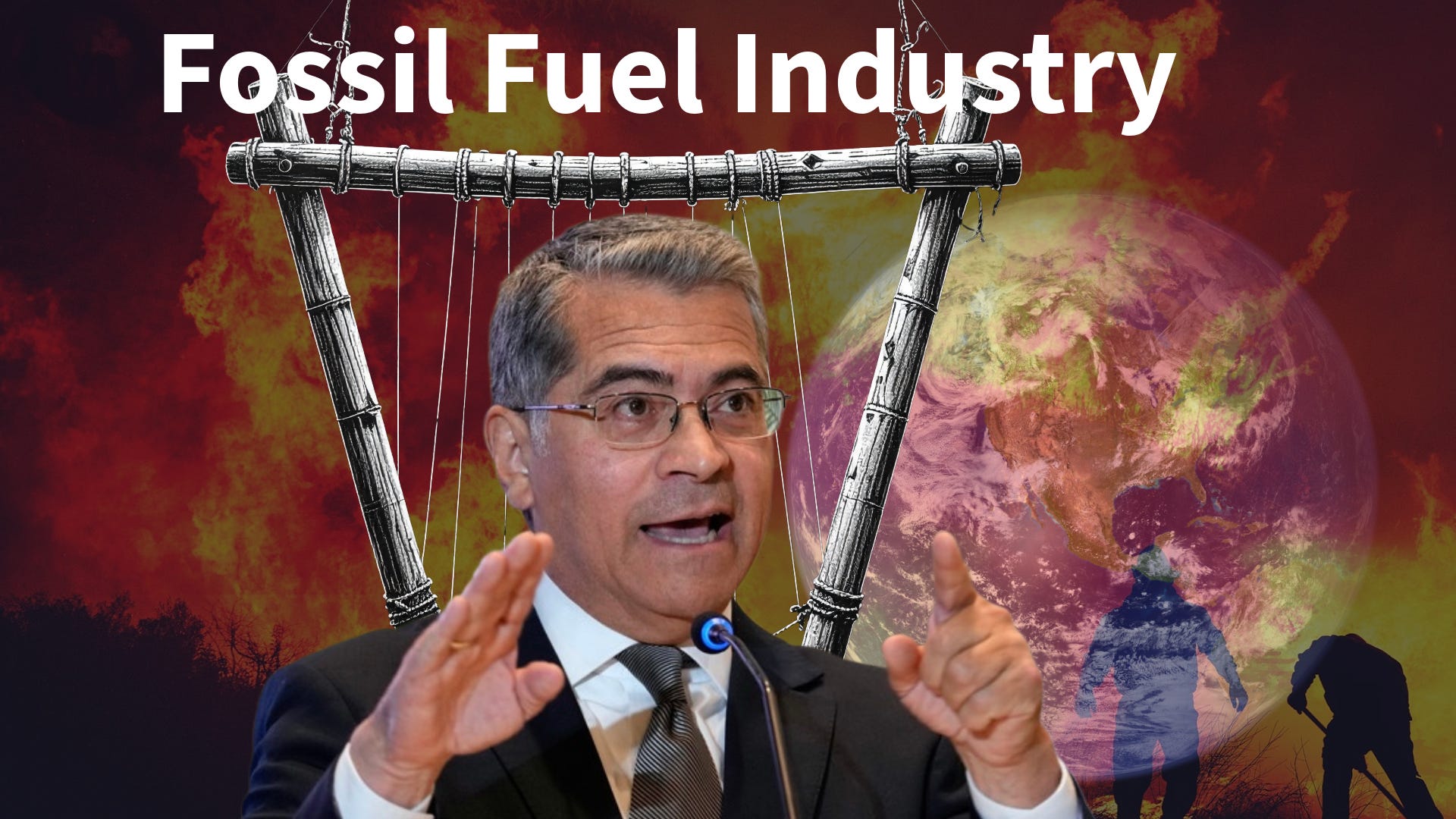
I study the Universe. I am a professor of physics and astronomy, and I have spent my career thinking about big quantitative questions. So when I tell you that we are running out of atmosphere, I do not mean it metaphorically. I mean it physically.
Every year we delay the energy transition, we lock in more warming, more wildfires, more crop failures, more climate refugees, more dead coral, more dead children from heat and smoke and storm. The physics does not negotiate. The carbon we put in the air this decade will be heating the planet long after every politician currently asking for our vote is dead. There is no “moderate” position on this. There is action, and there is acceleration toward global destruction. Everything in between is just acceleration with extra steps.
That is the lens through which Californians need to look at the June primary ballot. And through that lens, a vote for Xavier Becerra is a vote against the planet our children will inherit.
What the Science Actually Says
The IPCC’s Sixth Assessment Synthesis Report (2023) is the most authoritative statement we have on what climate change is doing to human civilization. It is sobering reading. The Panel finds, with high confidence, that warming is already driving:
Food insecurity and a slowdown in agricultural productivity, with crop productivity growth in Africa shrinking by roughly a third since 1961, and projected to worsen sharply with further warming.
Severe water scarcity affecting about half the global population for at least one month per year.
Ocean acidification, sea level rise, and salinization of coastal aquifers and farmland.
Accelerating biodiversity loss, with adaptation already reaching its limits in some ecosystems.
The spread of vector-borne diseases (malaria, West Nile, Lyme) into new regions.
Displacement of more than 20 million people from their homes every year since 2008.
Roughly 3 to 3.6 billion people now living in contexts highly vulnerable to climate change.
The IPCC is explicit that with further warming, these risks become compounding and cascading, with climate-driven food insecurity and supply instability interacting with land competition, pandemics, and conflict. We are not talking about an inconvenience. We are talking about the destabilization of the biophysical systems on which human civilization is built.
The Bulletin of the Atomic Scientists, the body founded in 1945 by Manhattan Project veterans that maintains the Doomsday Clock, agrees. Climate change has been one of the existential threats it formally tracks since 2007. In January 2026 the Bulletin set the Clock to 85 seconds to midnight, the closest to catastrophe it has ever been, citing nuclear weapons, climate change, biotechnology, and ungoverned AI together as the principal existential risks to humanity.
The Future of Life Institute, founded by physicist Max Tegmark and other scientists to study and reduce existential risk, lists exactly the same four categories of large-scale threat to human survival: climate change, pandemics, nuclear weapons, and ungoverned AI. When the world’s leading existential-risk researchers list the things that could end human civilization, climate change is on every list.
This is not a partisan position. This is the scientific consensus.
The Clock Is Already Running
How much time do we actually have?
The 2025 Indicators of Global Climate Change report (Forster et al., from an international team of more than 60 scientists tracking climate indicators between IPCC assessments) estimated the remaining carbon budget for a 50% chance of holding warming to 1.5°C at roughly 130 gigatonnes of CO2 as of the start of 2025. At current emissions of about 42 gigatonnes per year, that is around three years. Three. The 2025 Global Carbon Budget update put the 1.5°C figure at about 170 gigatonnes, or four years. The budget for 1.7°C is about a decade. The budget for 2°C is around two decades and shrinking.
That is the time horizon. Not “by 2100.” Not “for future generations.” Now. The decisions California’s next Governor makes in their first term will determine whether we squander what little budget remains or use it to bend the curve.
The False Choice
The defining lie of climate politics in 2026 is that climate responsibility and affordability are opposed, that Californians have to choose between a livable planet and a livable budget. Becerra has built his climate pitch around exactly this framing: a “pragmatic” transition, slower targets, easier on industry, and (as he announced in a recent debate) easier on the Kern County drillers he had opposed as Attorney General.
It is a false choice. The numbers say so plainly.
I teach Physics 14 at UC Irvine, our undergraduate course on energy, environment, and climate. Every quarter, my students work through the actual physics of our energy system, and every quarter they finish with the same conclusion: a fully renewable, carbon-free energy system is achievable within our existing technological and financial constraints. The path exists. The only question is whether we have the political will to take it.
Lazard’s 2025 Levelized Cost of Energy report, the industry-standard analysis used by utilities, banks, and grid planners, finds that utility-scale solar and onshore wind are the most cost-effective forms of new-build generation in the United States, even on an unsubsidized basis. New solar comes in as low as $38 per megawatt-hour. Onshore wind starts around $37. New combined-cycle gas runs $48 to $107. New nuclear sits at $141 to $220. Wind and solar are not just competitive. They are, by a substantial margin, the cheapest electricity humanity has ever produced, and the fastest to deploy.
Add in the costs we currently externalize (the asthma, the heart attacks, the wildfire smoke, the flooded basements, the collapsing insurance markets, the lost agricultural yields), and fossil fuels are not just more expensive. They are not in the same league.
So when a politician tells you that aggressive climate action will hurt working families, ask: more expensive than what? More expensive than the cheapest electricity humanity has ever produced? More expensive than the fires that just burned through Los Angeles? More expensive than the homeowners insurance market unraveling across this state?
The affordability argument against climate action is not an argument. It is a talking point. And it is a talking point with a paymaster.
Who Pays for the Talking Point
The cheapest energy in human history dismantles the most profitable business model in human history. That is not a coincidence. That is the entire fight. Cheap solar plus cheap wind plus cheap storage plus cheap heat pumps plus cheap EVs is an existential threat to every oil major on Earth, because it converts their reserves into stranded assets and their political influence into a sunset industry.
So they spend. They lobby. They donate. They fund “moderate” Democrats willing to slow-walk the transition: politicians who soften the framing, oppose the bills that would make polluters pay, reopen the drilling fields, and shake hands with Chevron while calling it pragmatism.
Becerra accepted a $39,200 donation from Chevron for his gubernatorial campaign. As California Attorney General, he opposed proposed legislation that would have made fossil fuel companies pay for the climate damages they knowingly caused. The Center for Biological Diversity Action Fund gave him a C+ on its environmental scorecard. Greenpeace USA gave him a D on its 2026 California Climate Leadership Scorecard, supporting only two of nine climate benchmarks. And in the May debate, he reversed his AG-era position and said he would support reopening oil drilling in Kern County.
By contrast, Greenpeace gave Katie Porter and Tom Steyer A grades on the same scorecard. Porter scored 100% on the League of Conservation Voters Scorecard during her time in Congress and held oil companies accountable for spills and gas-price gouging as chair of the House Natural Resources Subcommittee on Oversight.
Big Oil knows the difference. So should we.
I Am Voting for Katie Porter
I am voting for Katie Porter. She has built her career on the positions of everyday Californians, on holding the powerful accountable, and on telling the truth about how money distorts public policy. She is the kind of person we need at this moment: someone who reads the science, says what it says, and is not for sale to the industry whose business model depends on burning the planet.
If California had ranked choice voting (and we should), I would rank Tom Steyer second. He has spent his fortune and the better part of two decades trying to force American politics to take climate seriously, and his A grade on the Greenpeace scorecard is earned.
But we do not have ranked choice voting yet. We have a single vote in a crowded field, and the stakes are not rhetorical. A vote for a D-graded candidate, funded by Chevron, eager to reopen oil fields, and offering “affordability” as cover for delay, is a vote for the fossil fuel industry’s preferred timeline. That timeline ends with the destruction of the climatic conditions under which our species developed civilization.
A vote for Katie Porter is a vote for the cheapest, fastest, and most just energy transition humanity is capable of, and against the industry actively trying to prevent it.
The carbon budget gives us three years. The Doomsday Clock gives us 85 seconds. The choice is clarifying.
Vote like the planet depends on it.
It does.
A vote for Katie is a vote for Bacerra.
Katie cant win. If you were serious you would have told us to vote for Tom Steyer.